artist: Nadia Berghella
Geographical distribution and habitats
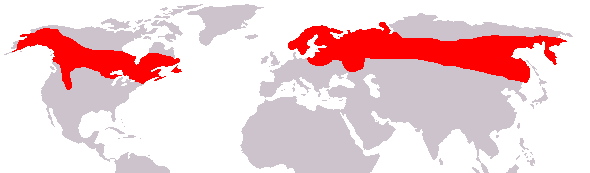
The moose (Alces alces) lives in mixed and boreal forest in North America but also on the Eurasian continent where it is called “elk”. In North America, the species occupies a vast territory comprised between Alaska and Newfounland. The population of moose is estimated at 500 000 to one million specimens on the Canadian territory only.
HERE in the park
The moose found in Massif du Sud regional park mainly live in the higher zones, where the alpine climate produces a resinous vegetation on which they feed. In order to fulfill all its vital needs and adapt to the changes of the seasons, the moose also has to move through a number of different habitats, most of which can be found within the limits of the park. It explains the high density of the species in the area. Some studies conducted in 2004 and 2005 show that 13 moose can be found per 10km2 in the park, in comparison to 6 moose per 10km2 in the rest of the area.
The habitats in which the moose fulfill its needs are:
- Clearings, natural or man-made by logging activities, with an abundant shrub layer to feed;
- Wetlands offering aquatic plants rich in minerals and a cooling area for the summer period;
- Dense forest acting as a shelter and protection, reducing hunting mortalities;
- Coniferous forests to provide shade in the summer time and shelter from the wind in the winter time.
This diversity of habitats is necessary to maintain the high density of moose in the park.
Did you know?
The moose accommodates itself well of the logging activities as it increases the shrub layer, an important food source. This explains, in part, why the specie can now be found where it was originally absent before the colonization such as the center-north of Ontario and the south of British Columbia. In Quebec, it was only at the beginning of the 20th century that the moose started to travel to the north shore of the St Lawrence river. It now travels even further north, in the cleared forested area preceding the tundra.
Description
The moose is the biggest of the deer family, including also the caribou and the white-tailed deer. It can reach a height of two meters while his weight varies from 329 to 635 kg for the male and 227 to 408 kg for the female. The calf can weigh between 11 and 16 kg at birth. The adult moose is a dark brown colour with gray legs and sports a dewlap (goatee), a droopy upper lip and a bump on the shoulders.
Only the male wear antlers, which grow from April to August and shed its velvet cover in September. The older moose loses its antler in December or January while the younger one will keep it until February. During the first years of its life, the moose’s antler is smaller but it will gradually become more sophisticated, gaining the broad and palmate characteristics and reaching sometimes over 1,5 meters in size.
HERE in the park
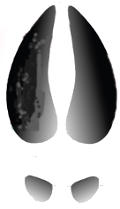
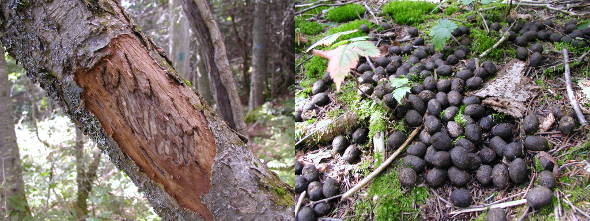
Because of its impressive size, the moose frequently uses the trail and road networks to navigate throughout the park. There are plenty signs of its presence and most are easy to interpret by an attentive hiker. Its print reveals a split hoof, similar to that of its cousin the deer but larger and bigger. Its excrements are a pile of egg-shaped pellets of about an inch.
Shrubs with broken branches and young trees missing long shreds of bark are signs of its big appetite. The moose has a fine ear and even the quietest hiker will mostly only see its large figure running away noisily.
Did you know?
The moose doesn’t have maxillary incisors as they are replaced by a cartilaginous plate. Unlike rodents (porcupine, marmot, etc.) and lagomorphs (hare) who slice the twigs on which they feed, the moose tears off the stems and twigs by pinching them between its mandibular incisors and its palate.
Diet and wetlands
The moose being a ruminant, it feeds, during the summer period, on leaves and a number of aquatic plants such as waterlily, eelgrass, horsetail and sagittaria. The moose can spend many hours per day in the water, its head underneath the surface to grab and feed on the plants. It is particularly fond of natural mineral water sources, in order to fulfill its need in minerals.

Wetlands play an important part in the ecosystems and, even though they only represent a small portion of the earth’s surface, they house a high concentration of species: riparian and aquatic plants, invertebrates, fish, amphibians, reptiles, birds and mammals. They act as a natural purification station and contribute to the conservation of a high quality of water. Wetlands are unfortunately declining around the world as irrigation, drainage, industrialization, contamination, embankment and urbanization activities are putting constant pressure on the habitat.
HERE in the park
In the summer time, the moose mostly stays in forests of birch and the few wetlands located in the height of Massif du Sud regional park. It makes roundtrip between these two habitats, finding foliage and rest in one and shade and nutritious plants in the other. It is hence vital to protect the wetlands of the park to maintain the moose population as well as the other species depending on these ecosystems.
To protect the habitat, the regional county municipalities (MRC) of Bellechasse and Etchemins signed an agreement, in 2014, with the ministry responsible for the forests, fauna and parks in Quebec (MFFP) to frame the development and lumbering activities in the park. It was agreed to prohibit any logging activities within twenty meters of any stream, and to allow the cutting of trees at a distance of 20 to 40 meters of a stream up to 40% of the forest cover. On top of that, according to this agreement, the Milieu and Beaudoin river watershed are now fully protected.
Did you know?
The moose can dive up to five meters deep to reach aquatic plants and can stay under water as long as a minute because of a special feature: its nostrils can close while it is underwater, preventing water from entering.
Survival during the winter period
During the long winter season, the moose looks for mixed forests made of densely resinous trees to shelter itself from the wind and snow and younger leafy trees for feeding purposes. It consumes the bark, twigs and buds of a number of woody species such as the balsam fir, mountain maple, birch, poplar, mountain-ash, willow and viburnum.
HERE in the park
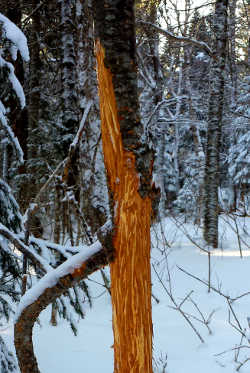 Massif du Sud’s fir forests, located in the upper part of the park, are the ideal habitat for the moose during the winter season because they meet its needs. The strong winds blowing over the upper parts of the mountains occasionally destroy parts of old tree population, leaving room for a young vegetation to take its place and providing the moose with tender twigs to feed on. Logging activities, allowed only on certain portions of the territory, also enable the rejuvenation of the forest and thus favour the moose population.
In the midst of winter, the snow coverage will slow down and tire the moose in its travels. The giant will sometimes group with other individuals, in parties of between two and eight specimens, and travel in dense fir forests, where the snow coverage is lighter. The group traces a network of paths to travel faster and access more easily to the food supply and will rarely go out of these tracks. These intensive grazing areas are called moose yards and can easily be seen in the park because of the high density of the moose population on its territory.
Reproduction cycle
The mating period is generally between mid-September to the beginning of October, sometimes extending until the end of November. The males usually fight for a female sometimes going as far as sparring antlers. During the mating period, the female produces a sound that can be carried over 3 kilometers while the male produces hoarse sounds. It also sometimes scrapes its antler on trees and digs pit holes in which it urinates to attract the females. These depressions are important meeting points for the male and the female. The male stays with the female only until its ovulation, reproduces and then seeks other female to reproduce with during the same mating period.
Litter size
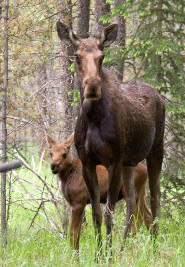
The youngs, called calves, are born after an eight month gestation period. Births are usually around the end pof May or the beginning of June, and the female tends to give birth on a river bank or on a bushy islet. The moose has a litter of one or two calves per year, very rarely giving birth to three calves at a time. The calf is a red-brown colour and can walk on its own only minutes after its birth. A few weeks later only, it will be able to follow its mother in all its travel, even through water. The calf is weaned after a five-month period but stays with its mother up to ten days before the birth of the new litter. It reaches sexual maturity at the age of eighteen months although the female rarely mates before the age of two and a half and the male before the age of five. The moose can live up to twenty years in its natural environment while the record for longevity, in captivity, is twenty-seven years old.
Did you know?
The calf is the fastest growing species of all big mammals. The new-born weighs bewteen 11 and 16 kg and gains up to 13 times its weigh within a six month period! Its growth is usually complete by the age of six.